
Who Is Left When the Mind Fades? A PATH Journey Through Illness, Identity, and Love
Who Is Left When the Mind Fades? A PATH Journey Through Illness, Identity, and Love
Inspired by Crystal Jing Jing Yeo, “Who is left, when illness takes away your mind or body?”, The Straits Times, Opinion, 5 December 2025.
When illness quietly unravels someone you love, the hardest questions are not medical.
They sound more like this:
Who is left when memory disappears?
Who is left when a body you recognise no longer responds?
Who are we in the face of that?
In her Straits Times article, neurologist Dr Crystal Yeo describes a woman who once loved cooking, gardening, laughter and family. Then the small clues arrived. Forgotten items. Repeated questions. Growing anxiety. Withdrawal. Within weeks, seizures emerged. Speech vanished. A life that used to feel wide and colourful narrowed into a bed, a tube, and eyes that no longer seemed to focus.
For the family, the grief is not just about death. It is about continuity being snapped in half.
From my PATH framework, I want to stay with that experience and go deeper. Not only “Who is left?” but:
What do we mean by “self” when the brain or body changes dramatically?
How do Eastern philosophies and Western clinical science talk to each other on this question?
And how do families love someone well when so much that used to define them has fallen away?
Let’s walk through this gently, but honestly.
1. Three layers of self: body, story, and field
Modern medicine usually starts with the visible and measurable: brain scans, nerve pathways, diagnostic labels. From that angle, “self” often gets quietly equated with brain function.
Western neuroscience talks about at least two important layers of self:
The minimal self
This is the basic, moment-to-moment sense of “I am here in this body right now.” It is tied to sensory systems, posture, pain, breath, and orientation.
The narrative self
This is the story you carry about who you are: your memories, achievements, wounds, roles, and hopes for the future. It stretches across time: “I was… I am… I will be…”
In diseases like Creutzfeldt-Jakob disease or advanced dementia, the narrative self is brutally attacked. Memories evaporate. Language fragments. The personality that once felt stable begins to shift. Familieslook at the person in the bed and whisper, “She is not herself anymore.”
PATH adds a third layer that Western medicine often underplays:
The relational-field self
This is the “you” that lives between people, not just inside your skull. It lives in family rituals, recipes, phrases, the way your laughter changed the emotional temperature of a room, the way you comforted a child, the way others still think, “What would Mum say here?”
Illness can devastate the body and break the storyline.
But the relational field is harder to erase.
Eastern philosophies have been talking about this for centuries.
2. Confucianism: You are your relationships
From a Confucian perspective, a person is never just an isolated individual. You are always embedded in roles: child, parent, grandparent, sibling, neighbour, teacher, elder.
Your worth is not measured only by how sharp your memory is or how eloquently you speak. The key question is:
Am I living out my roles with humanity (仁, ren) and proper conduct (礼, li)?
So when families say, “She is not herself anymore,” Confucian thinking would gently say, “She is still Mother, still Grandmother, still Wife, even if she cannot act those roles in the way she once did.”
Her internal capacities are changing.
But her relational identity still lives:
in the way her children still feel guided by her values
in the way her grandchildren use her recipes
in the way the family echoes her sayings and habits without even realising it
Filial piety in late illness is no longer about obeying instructions. It becomes about guarding dignity, protecting safety, and carrying forward the best of her character when she can no longer do it herself.
When I wear my PATH hat, I often invite families to shift the question:
Not “Is she still herself?”
But “How do I still be her child in a way that honours who she has been, even if she cannot recognise me today?”
That shift sounds small. It’s not. It moves us from trying to measure identity to choosing how to live it.
3. Daoism: The self as a river, not a statue
Where Confucianism focuses on roles and ethics, Daoism focuses on flow.
Laozi and Zhuangzi remind us that life is always moving. Trying to fix things into rigid permanence creates suffering. The person you were at twenty is not the person you are at seventy. Change is not the exception; it is the rule.
Severe illness forces this truth on us in a violent way.
When a joyful, capable woman becomes bedridden and mute in a matter of months, it feels like betrayal. The “statue” of who she was is shattered. You look at her and think, “This is not her.”
From a Daoist perspective, what is happening is not the disappearance of self, but an extreme shift in the river’s flow.
Before illness: the river was energetic, clear, easy to recognise.
During illness: the river is turbulent, shallow in places, hard to navigate.
Eventually: the river will empty into the sea, as all lives do.
The task is not to pretend this is fine. It isn’t. It hurts.
But instead of clinging to a frozen picture of who the person must be, Daoism invites another posture:
How can I move with this change with as much humility, flexibility, and care as I can manage today?
In PATH, this aligns with acceptance-based therapies like ACT and with Japanese Morita therapy: we do not deny grief or fear, but we also stop fighting reality as if sheer willpower can force the illness to reverse. When we stop that fight, more emotional energy becomes available for presence and love.
4. Buddhism and Western psychology: When “self” softens, what remains?
Buddhism goes even further and says: the solid, permanent “self” we cling to is never as solid as it looks.
A person, in Buddhist teaching, is a temporary combination of:
body
sensations
perceptions
mental formations
consciousness
These are always in motion. There is no fixed “I” behind them that remains unchanged. In illness, what we experience as “loss of self” is often the breaking of familiar patterns rather than the disappearance of some eternal object.
Western psychology, especially Acceptance and Commitment Therapy (ACT), mirrors this with the idea of:
self-as-content
All the details of your story: “I am a teacher, a runner, a good cook. I remember my grandchildren’s names. I am independent.”
self-as-context
The observing awareness that notices experiences coming and going. The “space” in which thoughts, emotions, and sensations appear and disappear.
In neurological illness, self-as-content clearly breaks down. The story fragments. The roles become impossible to enact. Families watching this often feel, “He is gone,” even while his body is still here.
But self-as-context may still flicker:
a softening of the eyes at a familiar song
a brief smile when a grandchild’s voice appears
a hand that grips back, however weakly, when you hold it
Neuroscience can describe this as residual networks, implicit memory, emotional memory. Eastern contemplative traditions might call it the subtle stream of awareness that illness has not fully extinguished.
PATH does not romanticise this. We do not pretend that a split-second of eye contact somehow cancels the brutality of the disease. But we also don’t throw it away.
Those little flashes are often where families can still meet the person, however briefly.
5. PATH in practice: How to love someone when so much is gone
All this philosophy and brain science is helpful, but at 2am by a hospital bed, you also need something very concrete.
Here are four PATH-informed practices I often suggest to families.
1. Change the question you ask yourself
Instead of “Is she still herself?” try:
“What part of her way of being can I honour today?”
“If I live as the child or spouse she raised me to be, how would I show up in this moment?”
This pulls you out of a hopeless, unanswerable measurement game and into meaningful action.
2. Create a “relational altar”
Not necessarily a religious altar. Think of it as a living archive of her relational self:
photos of her in her strongest years
her favourite sayings written down
recipes, songs, memories shared among family members
small objects that represent her values or humour
The goal is not nostalgia. The goal is to keep her presence active in the family field, so the illness does not get the final say on who she was.
3. Use Naikan-style reflection
Once a week, sit quietly and reflect on three questions about this person:
What have I received from her?
What have I given to her?
What troubles or burdens have I caused her?
This Japanese practice helps rebalance the mind. In the stress of caregiving, it is easy to be consumed by “What this illness is doing to me.” Naikan gently widens the view and reconnects you with the decades of unseen love that came before this chapter.
4. Practice micro-presence
When conversation is no longer possible, aim for micro-moments instead of big “deep talks.”
One song played all the way through, while you sit beside her.
One simple story from the past, told slowly, even if she cannot reply.
One minute of holding her hand and breathing in sync.
These may look small on the outside. On the inside, they are often enormous. They register in the brain’s emotional systems. And in the relational field, they become part of the family story: “Even at the end, we stayed with her.”
6. So… who is left?
Dr Yeo’s article raises a brave and necessary question for our aging, medically sophisticated society: Who are we when the brain or body breaks down?
PATH, integrating Confucianism, Daoism, Buddhism, and Western clinical science, offers this answer:
You are not only your memory.
You are not only your speech.
You are not only your independence.
You are also:
the relationships that shaped you and that you shaped
the values you lived, which now live on in others
the traces of kindness, courage, humour, and love that continue to move through your family and community
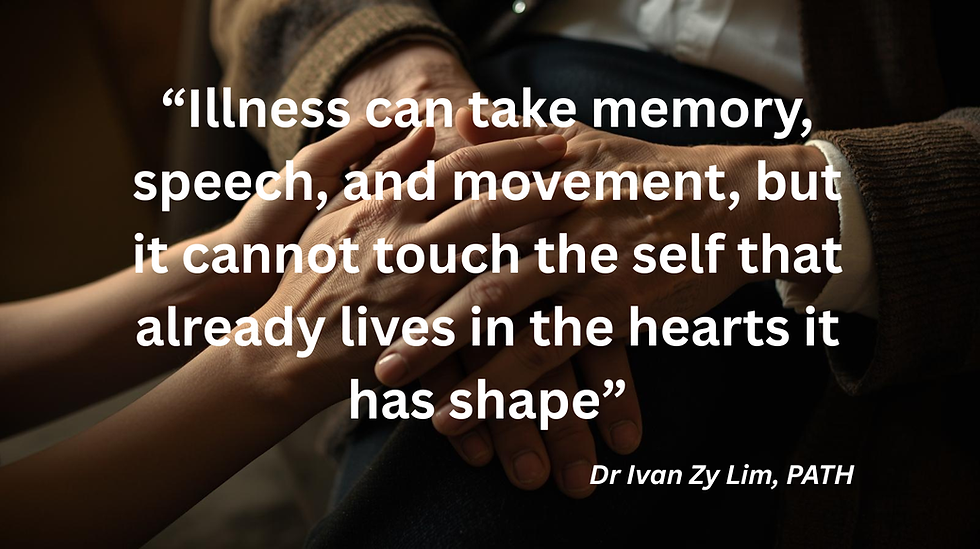
Illness can take away memory, words, and movement. It can dismantle the narrative self in devastating ways.
But it cannot erase the fact that your life has already entered other lives.
For families, that means this:
Every interaction now, even in silence, is not just “caregiving.” It is part of the final chapter of who this person is in the world. How you speak, how you touch, how you remember, and how you tell the story forward, all become part of their identity.
That is a heavy responsibility.
It is also a quiet, powerful hope.


Comments